• Jamestown (HQ)
  • Buffalo
  • Pittsburgh
  • Rochester
  • Syracuse
  • Erie
  • Contact
Access Elevator
  • Elevators
    • Home Elevator Installation
      • Traditional Home Elevators
        • Hydraulic Home Elevators
        • Inline Gear Drive Elevator
        • LULA
      • Luxury Home Elevators
        • Hydraulic Home Elevators
        • Inline Gear Drive Elevator
        • Glass Home Elevators
        • Cibes Air
        • LULA
      • Small Footprint Home Elevators
        • Hydraulic Home Elevators
        • Inline Gear Drive Elevator
        • Cibes Air
      • Home Accessibility Elevators
        • Cibes Air
        • LULA
      • Home Elevator Door Options
    • Commercial Elevator Installation
      • LULA
  • Stair & Wheelchair Lifts
        • Stair Lift Installation
          • Straight
          • Curved
        • Platform / Wheelchair Lift Installation
          • Platform Lifts for Homes
          • Platform Lifts for Businesses
  • Service & Modernization
  • Areas We Serve
        • Central & Upstate New York
          • Rochester
          • Syracuse
        • Western New York
          • Jamestown
          • Buffalo
        • Western Pennsylvania
          • Pittsburgh
          • Erie
  • About
    • Blog
    • Portfolio
    • Architect and Builder Resources
  • Menu Menu

Curved Stairlift Installation: Custom Rails, Models, and What to Expect

A curved staircase does not close the door on a stairlift. It opens a more precise conversation. Curved stairlifts are built specifically for the staircase in front of them: every bend, every landing, every change in angle. That specificity is what makes them more involved and more expensive than straight stairlifts, and it is also what makes them the right solution for the wide variety of staircase configurations found throughout Upstate, Central, and Western New York.

Homes across Buffalo, Jamestown, Rochester, Syracuse, and Erie range from Victorian-era builds with tight switchback staircases to mid-century construction with broad L-shaped turns. No two curved staircase installations are identical, and no standard product can serve them all. Custom fabrication is not an upsell in this category. It is the prerequisite.

This guide explains how curved stairlift installation works, which models Access Elevator carries, and what families should understand before the process begins, whether they are researching for themselves or on behalf of a loved one.

What Makes a Staircase “Curved” for Stairlift Purposes?

The distinction between straight and curved stairlifts is not about visual aesthetics. It is a functional question: can the rail be standardized, or must it be custom-built? The answer determines the entire product category, the fabrication process, and the cost.

Configurations That Require a Curved Stairlift

Any of the following staircase configurations requires a curved stairlift with a custom-fabricated rail:

A staircase that turns 90 degrees, sometimes called an L-shape, with or without a landing platform at the turn. A staircase with a 180-degree turn, called a U-shape or switchback, with a landing between the two flights. A staircase with a flat intermediate landing anywhere along the run, even if the flights above and below are otherwise straight. A spiral or helical staircase. A staircase with a subtle curve at the very top or bottom of the run, even one that appears nearly straight throughout the middle.

That final scenario surprises many families. A staircase that is straight for ninety percent of its run but curves at either end still requires a curved rail for the entire length. The rail must follow the staircase’s actual geometry, not an approximation of it.

Why This Is Common Across the Access Elevator Service Area

The housing stock throughout our New York and Pennsylvania service area includes a substantial number of homes built before modern residential staircase standards were established. Many of these homes feature staircases that are narrower, steeper, or more architecturally varied than what contemporary construction typically produces. 

L-shaped stairs in Victorian-era Buffalo homes. Switchback configurations in row houses. Narrow, steeply pitched staircases in Jamestown and Rochester homes from the early twentieth century. These are curved stairlift applications, and they are common across all of Access Elevator’s service regions.

Why Staircase Type Cannot Always Be Confirmed Remotely

The distinction between straight and curved is obvious for some staircases and genuinely ambiguous for others. A phone description of the staircase, or photographs taken from a single angle, can lead to an incorrect assessment. The in-home visit is the only reliable way to confirm staircase type for configurations that are not clearly one or the other. Access Elevator’s state and factory-trained technicians have assessed staircases across all six service areas and know what to look for in each type of home.

Minimum Staircase Width Requirements

Most curved stairlift models require a clear staircase width of at least 28 to 30 inches. The Stannah Sadler 260 is the exception, purpose-built for staircases as narrow as 26 inches. For older homes throughout the region where staircase dimensions are frequently tighter than modern construction standards, the Sadler 260 and its perched seat is often what makes a curved stairlift installation possible where other models will not fit. 

If there is any uncertainty about whether the staircase is straight or curved, the in-home assessment resolves it in person and at no charge. Access Elevator is here to help guide you through the entire process and the assessment starts with a visit to the home.

Schedule Your In-Home Assessment

Stannah Curved Stairlift Models Available Through Access Elevator

All three Stannah curved models carry a lifetime warranty on the motor, gearbox, and rail. These are the three components most critical to long-term performance, and a lifetime warranty on all three represents a meaningful commitment from the manufacturer.

Stannah Siena 260

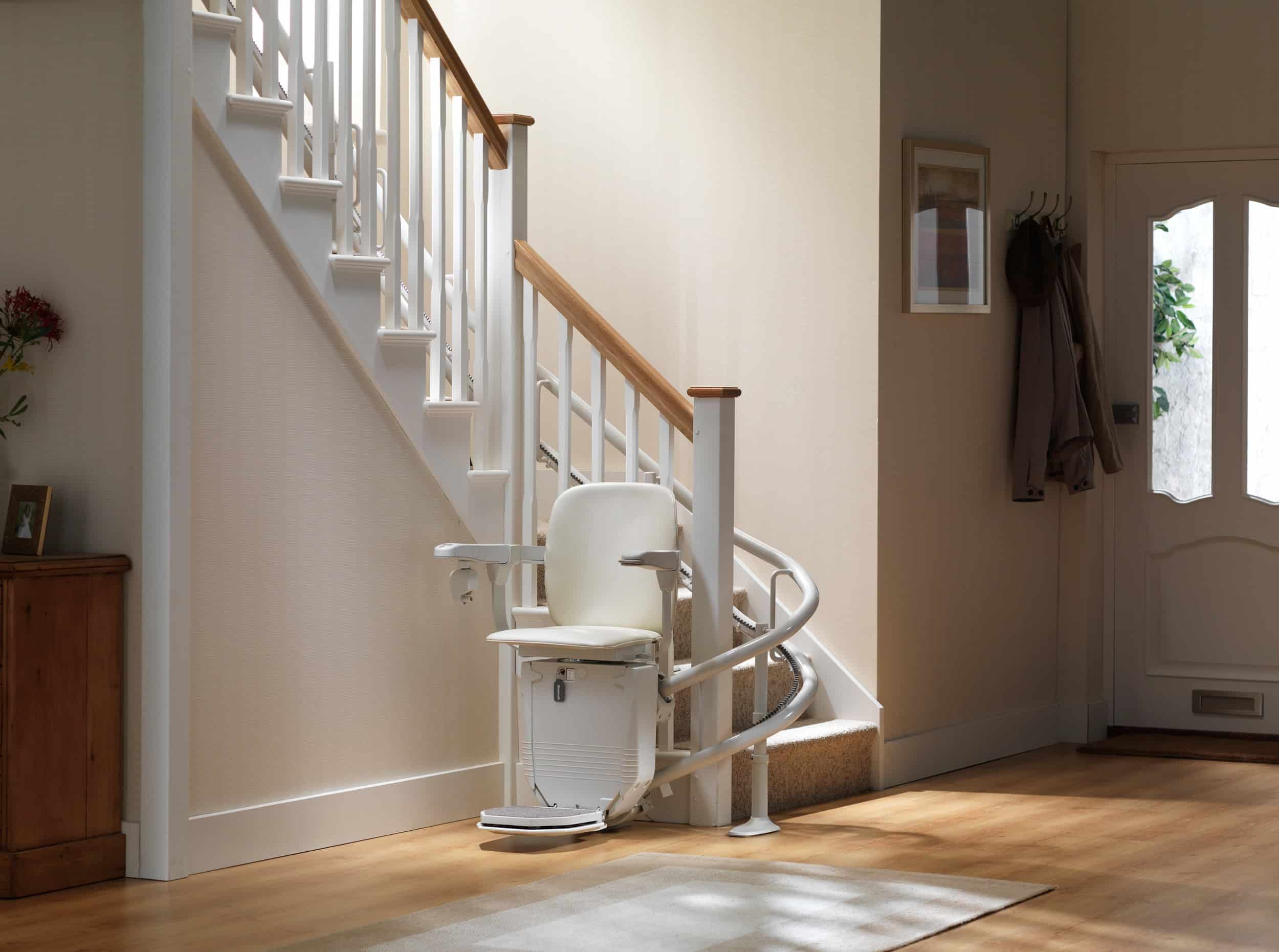
The Siena 260 is Stannah’s established curved stairlift, built for consistent performance across the full range of curved staircase configurations found in residential homes. It supports a weight capacity of 300 pounds, includes the full standard safety suite, and is the appropriate choice for most standard-width curved staircases. Across Buffalo, Rochester, Syracuse, Jamestown, and Erie, the Siena 260 is the most commonly installed curved model for homes where staircase width is not a limiting factor.

Stannah Siena 260 Curved Stairlift 27452341

Stannah Starla 260

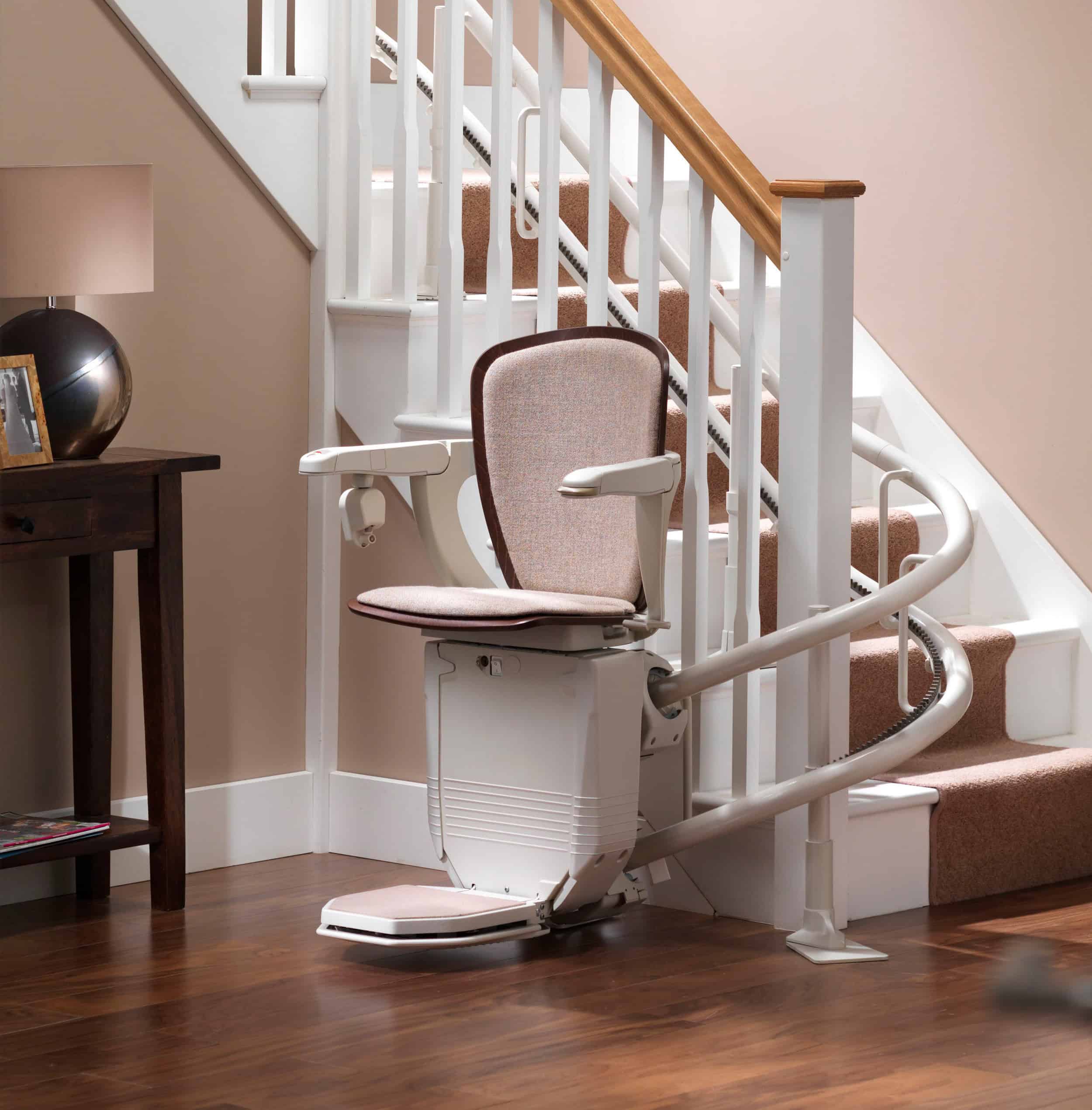
The Starla 260 builds on the Siena 260 with enhanced ergonomic comfort and seat adjustment options for users who have specific positioning needs or who use the lift multiple times daily. The weight capacity is identical at 300 pounds, and the lifetime warranty on the motor, gearbox, and rail applies equally to both models. For users with hip, knee, or lower back conditions that affect how they lower into or rise from a seated position, the Starla 260’s adjustability creates a meaningfully more comfortable ride over time.

Stannah Starla 260 Upholstery Rail Colours Curved Stairlift 1356432

Stannah Sadler 260

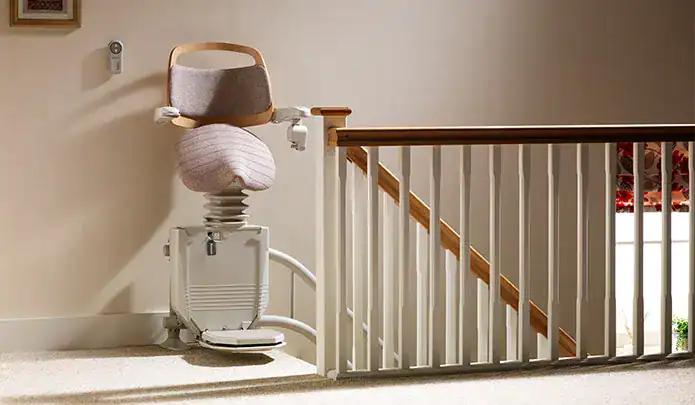
The Sadler 260 is purpose-built for narrow staircases, with a minimum staircase width requirement of 26 inches. It is not a compromise model. It is engineered specifically for narrow configurations and tested at that width for safe, reliable performance. It’s perched seat is also designed for the ease of use, convenience, and comfort of users with hip and knee mobility issues.

For homes across Jamestown and the older residential neighborhoods of Buffalo and Rochester where nineteenth and early twentieth century construction produced staircase widths that standard curved models cannot accommodate, the Sadler 260 with it’s unique seat shape is often the product that makes the installation possible at all.

The Sadler 260 carries a standard weight capacity of 300 pounds. When a hinged rail section is required because the rail would otherwise block doorway or landing access at the top of the staircase, the capacity with the hinged rail is 275 pounds. This is confirmed and documented clearly before installation.

Stannah Stairlift Sadler 2605027 695x405 (1)

Every curved staircase is different. See the models built to handle yours available for purchase and installation from Access Elevator.

See Our Curved Stairlift Options

Straight vs Curved: The Key Differences

Straight Stairlift Curved Stairlift
Staircase type Single direction, no turns Any turn, landing, or change of direction
Rail type Standardized, cut to length Custom-fabricated to staircase geometry
Installation Completed in a single visit, 2 to 4 hours Rail fabrication required; timeline confirmed at assessment
Weight capacity 300 lbs standard 300 lbs standard; 275 lbs with hinged rail
Warranty (motor, gearbox, rail) Manufacturer’s standard coverage Lifetime on all three
Investment Lower Higher; reflects custom fabrication

Why Curved Stairlifts Cost More Than Straight

The cost difference between a curved and straight stairlift is almost entirely attributable to the custom rail. A straight stairlift rail is a standardized product cut to the correct length during installation. A curved stairlift rail is manufactured to match the precise geometry of a specific staircase, incorporating every angle, turn, landing, and dimensional variable. That fabrication requires engineering time, specialized manufacturing, and materials that cannot be reused for another job.

Installation of a curved stairlift is also more technically involved than a straight installation. The technicians performing it are trained specifically for the additional complexity, and the process takes longer. The lifetime warranty on the motor, gearbox, and rail that accompanies curved models reflects a stronger warranty commitment than straight models carry, and that commitment has value that accrues over the life of the product.

For a realistic overview of what the investment looks like across straight and curved applications, and what factors drive pricing within each category, our stairlift cost guide provides the clearest available breakdown.

Stairlift Cost Guide

The Curved Installation Process: From Assessment to First Ride

Step 1: The In-Home Assessment

A factory-trained Access Elevator technician visits the home, measures the staircase in full, and confirms the configuration and appropriate model. Every dimension that matters for custom rail fabrication is captured during this visit. The assessment is free and carries no obligation.

For families across the service area where an adult child is managing the process on behalf of a parent, the assessment is the right time for everyone to be present. The technician can address questions from all parties, and the person who will use the lift has a direct opportunity to raise any specific concerns about the model, the installation, or daily operation.

Step 2: Custom Rail Fabrication

The measurements from the assessment are sent to fabrication. The rail is manufactured to match the exact geometry of the staircase, including every bend, angle, landing, and dimensional variable. This process is what makes a curved stairlift installation viable on a staircase that no standardized product could safely navigate.

Fabrication timelines vary and are confirmed at the time of assessment. Access Elevator communicates the expected timeline clearly so the household can plan accordingly. For situations involving urgency, such as a return home from hospital or a health event that has made the staircase suddenly unmanageable, the team is experienced in advising on what is feasible.

Step 3: Installation Day

The installation team arrives with the fabricated rail and all necessary equipment. The rail is mounted to the stair treads, not to the walls or structural elements, leaving the staircase structure intact. The stairlift carriage is attached, and the system is tested through a complete cycle before anything else happens. Once confirmed operational, the team walks every household member through the controls, remotes, safety belt, and swivel seat.

The lift is fully functional before the team leaves.

Step 4: The Walkthrough and Handoff

Before departing, the installation team demonstrates the full operation of the lift and answers any questions about daily use. For a parent who was not enthusiastic about the installation, this is often the moment where the product earns its place. An experienced technician explaining how the safety features work and addressing concerns directly tends to be more effective than any family member doing the same.

What Makes a Good Curved Stairlift Installer

The gap between a competent and an inadequate curved stairlift installer is larger than it is for straight stairlifts. The complexity of custom rail fabrication and the precision required during installation create meaningful variation in outcomes across installers.

Questions worth raising with any curved stairlift company before committing: 

  • How many curved installations has the team completed across different staircase configurations? 
  • Are the technicians who take the measurements the same technicians who install the rail, or are measurement and installation handled by different people? 
  • Who performs service calls if something needs attention after installation, and are they local? 
  • Is the rail fabricated to the actual staircase measurements, or adapted from a template designed to approximate the shape?

Access Elevator’s state certified and factory-trained technicians have completed curved stairlift installations across the full range of staircase configurations found in homes throughout Upstate, Central, and Western New York as well as Western Pennsylvania. The team that measures the staircase and the team that installs the rail are part of the same local operation, not separated by subcontracting.

Warranty and Service for Curved Stairlifts

All three Stannah curved models installed by Access Elevator carry a lifetime warranty on the motor, gearbox, and rail. Access Elevator’s labor warranty covers the installation itself, with specific terms confirmed in writing before installation. Beyond warranty coverage, Access Elevator provides scheduled maintenance visits and service calls for every curved stairlift installed across the service area.

Having a local service team is especially important for curved stairlifts. The custom rail means the technician who installed the lift and knows its specific configuration is always the most efficient option for any service need. That local continuity is not something a national chain or online retailer can replicate.

Curved Stairlift FAQs

Why does a curved stairlift cost significantly more than a straight one?

The cost difference comes from custom rail fabrication. A straight stairlift uses a standardized rail cut to fit. A curved rail is manufactured specifically for the staircase in front of it, incorporating every angle, bend, and dimensional variable. That fabrication cost, combined with a more technically involved installation, accounts for most of the price difference. The stairlift cost guide provides a full breakdown of what drives pricing across both types.

My parent’s staircase has one small turn at the top. Does it really need a custom curved rail?

Yes. Any turn anywhere on the staircase requires a custom rail. The rail must follow the staircase’s full geometry, and a straight rail cannot navigate a bend safely regardless of how minor it appears. The in-home assessment confirms this definitively for each specific staircase configuration.

How long does it take from first call to a working curved stairlift?

The in-home assessment happens quickly after first contact. Fabrication and installation timing is confirmed during the assessment and depends on current lead times. Access Elevator communicates the expected timeline clearly so the household can plan. For urgent situations involving a return from hospital or a recent fall, contact the team directly and describe the circumstances. The team is experienced in advising on what timelines are realistically achievable.

Our home is in an older part of the region with a narrow staircase. Are there options available?

Yes. The Stannah Sadler 260 is purpose-built for staircases as narrow as 26 inches. It was designed specifically for the kinds of narrow staircase configurations common in the older residential housing stock found throughout Buffalo, Jamestown, Rochester, Pittsburgh, Erie, and the surrounding communities. The in-home assessment confirms whether the Sadler 260 or one of the wider models is appropriate for the specific staircase.

What happens if a part needs to be replaced years after installation?

The lifetime warranty on the motor, gearbox, and rail covers the components most likely to need attention over the life of the lift. For other components, Stannah’s parts availability is strong, and Access Elevator’s local technicians handle repairs directly across all service areas. The advantage of a local dealer relationship is exactly this: a technician who knows the specific installation and can source parts without routing through a national process.

What happens to the custom rail if we eventually move?

The rail is fabricated for the specific staircase in the specific home. It cannot be transferred to a different property. If a move happens, the lift can be removed and the staircase is left fully intact. Access Elevator can assist in evaluating options for the new property if an accessibility solution is needed there.

Can the curved stairlift be used by multiple people in the household?

Yes. Any household member who can safely transfer to the seated position can use the lift, subject to the weight capacity of the specific model. Remote controls at both the top and bottom landing allow any household member to call or send the lift regardless of which landing they are on.

Enjoy Safer Mobility Backed By 55 Years of Regional Installation Experience

Access Elevator has been installing curved stairlifts in homes across Buffalo, Jamestown, Rochester, Syracuse, and Erie since 1969. The full range of staircase configurations found in the region’s housing stock, from the narrowest Victorian-era staircases to modern construction with broad 180-degree turns, is territory this team knows from direct experience.

The free in-home assessment is where every curved stairlift project starts. A factory-trained technician comes to the home, measures everything, and provides a clear recommendation and accurate written quote with no obligation and no pressure to decide on the day of the visit. When you are ready to begin the process we’re here to help. Reach out to schedule your free in-home evaluation with Access Elevator today. 
Share This Post

  • Share on Facebook
  • Share on X
  • Share on Pinterest
  • Share on LinkedIn
  • Share on Tumblr
  • Share on Vk
  • Share on Reddit
  • Share by Mail

More Like This

Stannah Siena 260 Curved Stairlift 27452341

How Much Does a Stairlift Cost in 2026? A Guide for Pittsburgh, Buffalo, Rochester, Syracuse, and Erie

Chair lifts
https://www.accesselevator.com/wp-content/uploads/2026/05/stannah-siena-260-curved-stairlift-27452341.jpg 1861 2500 Abstrakt Marketing /wp-content/uploads/2026/01/access-elevator.png Abstrakt Marketing2026-06-15 14:07:432026-06-18 10:41:38How Much Does a Stairlift Cost in 2026? A Guide for Pittsburgh, Buffalo, Rochester, Syracuse, and Erie
Cibes Air Textile Wool Staircase 1280x960 1

Myths About Chair Lifts that Sound Like Facts

Chair lifts
https://www.accesselevator.com/wp-content/uploads/2026/06/cibes-air-textile-wool-staircase-1280x960-1.jpg 1250 2000 Abstrakt Marketing /wp-content/uploads/2026/01/access-elevator.png Abstrakt Marketing2026-02-03 13:00:352026-06-18 10:41:50Myths About Chair Lifts that Sound Like Facts
Cibes Air Textile Wool Staircase 1280x960 1

Chair Lifts for Homes & Businesses: Enhancing Safety for All Spaces

Chair lifts
https://www.accesselevator.com/wp-content/uploads/2026/06/cibes-air-textile-wool-staircase-1280x960-1.jpg 1250 2000 Abstrakt Marketing /wp-content/uploads/2026/01/access-elevator.png Abstrakt Marketing2025-12-01 09:50:362026-06-18 10:42:09Chair Lifts for Homes & Businesses: Enhancing Safety for All Spaces
Cibes Air Textile Wool Staircase 1280x960 1

Chair lifts in Buffalo, Erie, Rochester and Syracuse.

Blog, Chair lifts
https://www.accesselevator.com/wp-content/uploads/2026/06/cibes-air-textile-wool-staircase-1280x960-1.jpg 1250 2000 Abstrakt Marketing /wp-content/uploads/2026/01/access-elevator.png Abstrakt Marketing2017-03-29 19:46:332026-06-18 10:57:23Chair lifts in Buffalo, Erie, Rochester and Syracuse.
Previous Previous Previous Next Next Next

Categories

  • Access News
  • Blog
  • Chair lifts
  • Curved chair lifts
  • Elevators
  • Home Elevators
  • Stairlift Installation
  • Stairway lifts
  • Uncategorized

Showrooms

Jamestown (HQ)

Western PA

Service Areas

Rochester

Syracuse

Erie

Buffalo

Morgantown

Deepcreek

Services

Home Elevators

Commercial Elevators

Stair Lifts

Platform / Wheelchair Lifts

About Us

Access Elevator provides high‑quality elevators, stairlifts, and wheelchair lifts for residential and commercial clients across NY and PA.

716.483.3696

Website by Abstrakt Marketing Group ©
  • Sitemap
  • Privacy Policy
Link to: How Much Does a Stairlift Cost in 2026? A Guide for Pittsburgh, Buffalo, Rochester, Syracuse, and Erie Link to: How Much Does a Stairlift Cost in 2026? A Guide for Pittsburgh, Buffalo, Rochester, Syracuse, and Erie How Much Does a Stairlift Cost in 2026? A Guide for Pittsburgh, Buffalo, Rochester,...Stannah Siena 260 Curved Stairlift 27452341 Link to: Straight Stairlift Installation: What to Expect in Western and Upstate New York Link to: Straight Stairlift Installation: What to Expect in Western and Upstate New York Stannah Straight Stair Lift In HomeStraight Stairlift Installation: What to Expect in Western and Upstate New ...
Scroll to top Scroll to top Scroll to top

This site uses cookies. By continuing to browse the site, you are agreeing to our use of cookies.

AcceptLearn more

Cookie and Privacy Settings


How we use cookies

We may request cookies to be set on your device. We use cookies to let us know when you visit our websites, how you interact with us, to enrich your user experience, and to customize your relationship with our website.

Click on the different category headings to find out more. You can also change some of your preferences. Note that blocking some types of cookies may impact your experience on our websites and the services we are able to offer.

Essential Website Cookies

These cookies are strictly necessary to provide you with services available through our website and to use some of its features.

Because these cookies are strictly necessary to deliver the website, refusing them will have impact how our site functions. You always can block or delete cookies by changing your browser settings and force blocking all cookies on this website. But this will always prompt you to accept/refuse cookies when revisiting our site.

We fully respect if you want to refuse cookies but to avoid asking you again and again kindly allow us to store a cookie for that. You are free to opt out any time or opt in for other cookies to get a better experience. If you refuse cookies we will remove all set cookies in our domain.

We provide you with a list of stored cookies on your computer in our domain so you can check what we stored. Due to security reasons we are not able to show or modify cookies from other domains. You can check these in your browser security settings.

Other external services

We also use different external services like Google Webfonts, Google Maps, and external Video providers. Since these providers may collect personal data like your IP address we allow you to block them here. Please be aware that this might heavily reduce the functionality and appearance of our site. Changes will take effect once you reload the page.

Google Webfont Settings:

Google Map Settings:

Google reCaptcha Settings:

Vimeo and Youtube video embeds:

Accept settingsHide notification only